
CUSTOM QA MANAGEMENT
A QA system built around the way your customer service operation measures, manages, and improves quality.
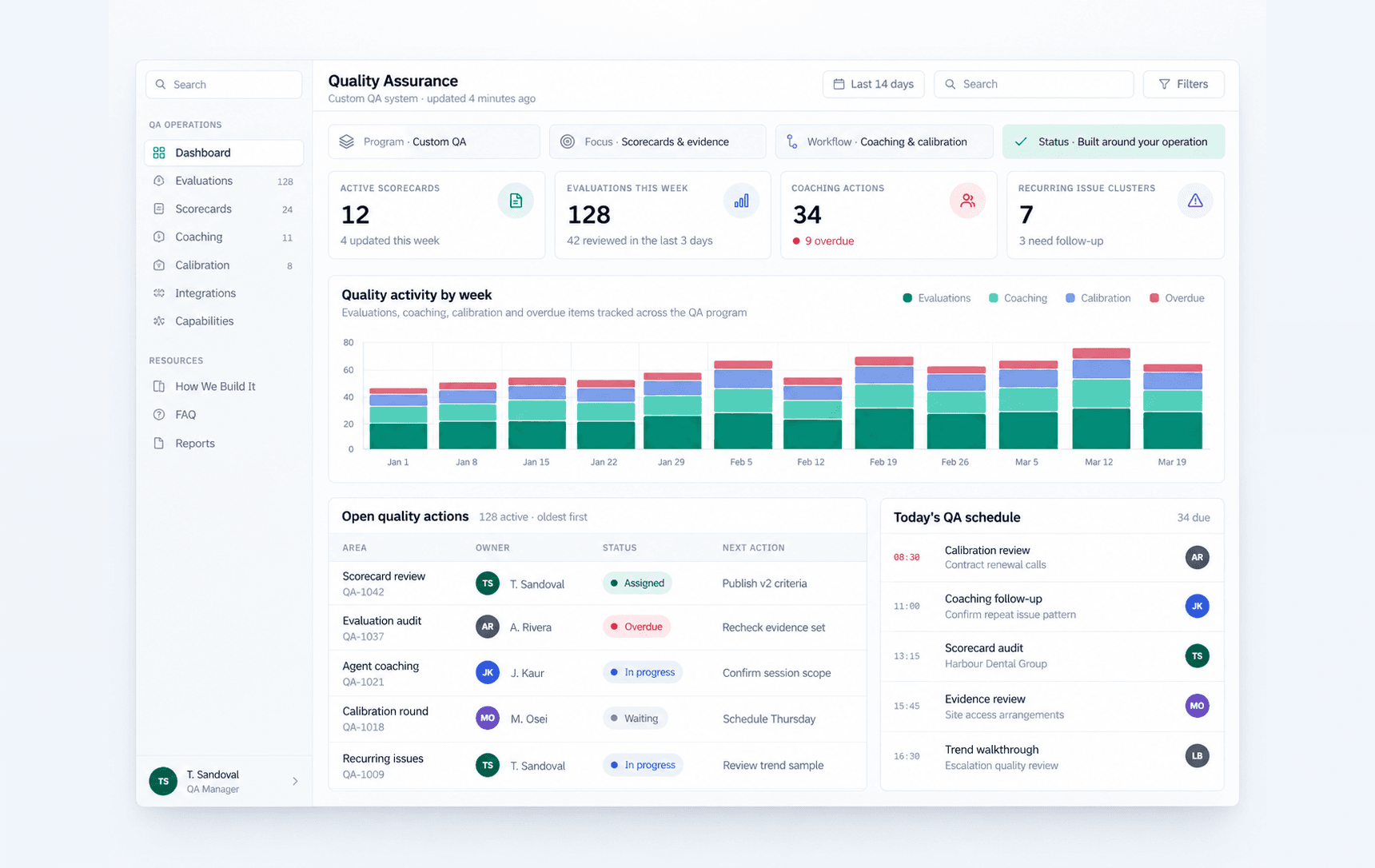
Off-the-shelf QA tools ask your team to work around predefined scorecards, processes, roles, and reporting. TrueArc builds the system around the way your QA operation actually works — from evaluation and quality analysis to coaching, improvement, and management visibility.
Custom-built around your QA operation.
WHY CUSTOM QA
Your QA process shouldn’t have to adapt to your QA software.
When evaluations live in spreadsheets, coaching is tracked separately, and quality results are difficult to connect across agents and teams, QA becomes harder to manage and harder to improve.
A custom QA system brings evaluation, analysis, coaching, and improvement together around the way your quality operation actually works.
Bring the QA operation together
Connect evaluations, quality results, coaching, development actions, and team performance in one structured system.
Evaluate quality your way
Shape scorecards, criteria, scoring rules, targets, roles, and review processes around the standards your operation actually uses.
Turn quality findings into improvement
Move beyond isolated scores by connecting recurring issues and quality signals to coaching, follow-ups, development, and measurable improvement.
QA CAPABILITIES
Bring your entire quality operation into one connected system.
From evaluations and quality analysis to coaching, development, calibration, reporting, and team performance, your QA system can be shaped around the way your customer service operation manages and improves quality.
CAPABILITY 01 / 09
Evaluate with scorecards built around your standards
Create evaluation scorecards around the criteria, scoring rules, weights, thresholds, and quality standards your operation actually uses.
QUALITY IMPROVEMENT LOOP
Turn every evaluation into the next improvement.
A strong QA operation doesn’t stop at scoring. It connects what you evaluate to what you understand, coach, improve, and measure again.
Evaluate
Review interactions against the standards and scorecards that matter to your operation.
Understand
See the patterns, failed attributes, recurring issues, and drivers behind the score.
Coach
Turn quality findings into focused coaching and development actions.
Improve
Track follow-ups and improvement work so findings lead to action instead of stopping at the evaluation.
Measure again
Evaluate again over time to see whether quality and performance are actually improving.
EVALUATE → UNDERSTAND → COACH → IMPROVE → MEASURE AGAIN
The loop is continuous. Measuring again is what turns the next evaluation into the next improvement rather than another isolated score.
BUILT AROUND YOUR QA OPERATION
Shape the system around the way your QA team actually works.
Your scorecards, roles, review process, sampling rules, coaching approach, calibration, appeals, targets, reporting, and follow-ups can all be designed around your operation.
Evaluation standards
Build scorecards around the criteria, scoring rules, weights, thresholds, and quality standards your operation uses.
Roles and permissions
Shape evaluator, team-leader, QA-lead, management, and other access around the responsibilities inside your operation.
Sampling and assignments
Define how evaluations are selected, assigned, distributed, and followed up based on your QA process.
Coaching and development
Connect findings to coaching, development plans, follow-ups, and the actions used to improve performance.
Calibration and appeals
Support the review, calibration, disagreement, and appeal processes your QA operation actually follows.
Targets and reporting
Build quality targets, dashboards, reporting, and performance views around the metrics your operation needs to measure.
WHY TRUEARC
Custom-built vs. ready-made QA
A ready-made QA platform gives you a predefined quality process to configure. A custom QA system is designed around the way your operation actually evaluates, manages, and improves quality.
TrueArc Custom QA
BUILT FOR YOU
Designed around your quality standards, team structure, QA process, coaching model, reporting, and the way your operation actually works.
- Built around your QA operation
- Scorecards shaped around your standards
- Roles and permissions defined around your structure
- Sampling and assignments built around your process
- Coaching and development shaped around your approach
- Calibration and appeals built around your policies
- Targets and reporting shaped around your metrics
- Integrations designed around your requirements and agreed scope
Ready-Made QA
A predefined platform that your QA operation configures around the options it provides.
- Your QA process adapts to the platform
- Predefined scorecard structures
- Standard roles and permission models
- Platform-defined sampling and assignment options
- Predefined coaching processes
- Supported calibration and appeal options
- Standard targets and reporting views
- Supported integrations only
AI CAPABILITIES
Add AI where it makes your QA operation smarter.
AI can support your QA operation where it creates real value — helping teams analyze interactions, assist evaluations, surface recurring issues, understand outcomes, and turn quality data into useful context.
The goal isn’t to add AI for the sake of it. It’s to use it where it makes quality work more useful and easier to understand.
MODEL COMPATIBILITY
Connect your QA system to leading AI models.
Choose the model and provider that best fits your use case, requirements, available data, and operation.
 OpenAI
 Anthropic
 Google Gemini
 DeepSeek
 Z.ai (GLM)
Shown to indicate integration compatibility. The right model depends on the project, the data available, and the agreed scope — and adding AI at all is optional.
AI LAYER · OPTIONAL
Analyze interactions
Use AI to help analyze interaction content and surface relevant quality context at scale.
Assist scoring
Use AI to support evaluators with scoring suggestions or quality signals where the available data and use case make it appropriate.
Detect recurring issues
Surface repeated quality problems, failed attributes, themes, and patterns that may be difficult to see one evaluation at a time.
Intelligent sampling
Use available data and quality signals to support smarter decisions about which interactions may deserve review.
AI LAYER
Inside your QA system
shaped to your use case
Summarize findings
Help turn evaluation and interaction data into concise summaries that make findings easier to review.
Support DSAT and root-cause analysis
Use AI as supporting context when analyzing dissatisfaction, controllability, recurring causes, and poor outcomes where the available data makes that feasible.
Quality insights at scale
Use AI to surface relevant patterns and context across larger volumes of quality data.
Support coaching
Turn quality findings into useful coaching context and possible development focus areas for the people responsible for coaching.
BUILT AROUND YOUR QA USE CASE
The exact AI capabilities depend on your QA process, the data available, technical feasibility, and where AI can provide meaningful value inside the system.
INTEGRATIONS
Connect QA to the systems and data your operation already relies on.
Bring the interaction, customer, and operational data your QA process needs into the system, and connect external tools where APIs are available and the integration is technically feasible and included in the agreed project scope.
- Interaction sources
- Customer and CRM data
- Operational systems
- Reporting and data sources
- Internal business tools
- Identity and access systems
Integrations are possible where suitable APIs or access exist, the integration is technically feasible, and it is included in the agreed project scope.
HOW WE BUILD IT
From understanding your QA operation to building the system around it.
You don’t need to be technical. We start by understanding how your QA operation works, then turn your decisions, quality process, scorecards, roles, rules, reporting needs, and requirements into a system built around it.
Understand your QA operation
We start by understanding the bigger picture — how evaluations happen, how teams work, what quality means to your operation, how findings are handled, and what you want the system to improve.
You explain the operation. We handle the technical translation.
Plan around your decisions
We go deeper into the scorecards, evaluation process, roles, permissions, sampling, coaching, data, reporting, integrations, and system behavior the project needs.
Define the project clearly
Before development begins, we define the agreed scope, project stages, expected timeline, pricing, and responsibilities.
The project is backed by a clear agreement so both sides know exactly what has been agreed.
Build with you in the loop
We handle the technical decisions and development. Whenever a decision affects your QA rules, operation, roles, scoring, or business process, we bring it back to you so the system stays aligned with your decisions.
Test, refine, and launch
After delivery, the system goes through the agreed testing process. Issues within the agreed scope are corrected, while additional changes or new requirements can be planned separately.
Warranty and ongoing support
A post-launch warranty period is defined in the agreement before development begins. After that, ongoing maintenance, support, and continued development can be arranged as needed.
FAQ
Questions worth answering before we start.
A few practical details about ownership, data, hosting, training, and how changes are handled throughout the project.
For fully purchased custom projects, ownership of the custom code developed specifically for the project transfers to the client after all agreed payments have been completed.
For subscription-based systems, the platform and source code remain with TrueArc while the client uses the system as part of the active service.
Reusable TrueArc components, third-party technologies, and external libraries remain subject to their respective ownership and licensing terms.
Your business data remains yours.
Whether the system is fully purchased or provided as a subscription, ownership of your operational and QA data remains with your business. Access, storage, export, and retention arrangements are defined as part of the project or service agreement.
Yes. Existing structured data can be migrated where technically feasible.
The exact migration depends on the format, volume, structure, and quality of the existing data and is defined as part of the agreed project scope. Complex cleanup or transformation may require additional work.
Yes. A custom system can be planned and delivered in phases when that approach makes sense for the project.
You can begin with the areas that matter most and extend the system later as new teams, QA processes, capabilities, or requirements are introduced.
Hosting depends on how the system is provided.
For fully purchased projects, hosting can be arranged on infrastructure owned or managed by the client depending on the agreed setup.
For subscription-based systems, hosting and system management are handled by TrueArc.
Any external infrastructure or third-party service costs are defined clearly in the agreement.
Yes. One onboarding and training session is included to help your team understand how to use the system.
If additional sessions, refresher training, or training for new team members are needed later, they can be arranged separately.
That’s completely possible.
If a new requirement appears during or after development, we review it with you first and clarify what it involves, including any impact on scope, cost, or timeline.
Additional work only moves forward once it has been clearly defined and agreed.
READY TO TALK?
Tell us how your QA operation works. We’ll build the system around it.
If your current QA tools don’t fit the way your team evaluates, understands, coaches, and improves quality, we can design a system that does.